Pages

Showing posts with label Middle East. Show all posts

Friday, January 25, 2013

Mali: A Defeat Waiting to Happen...

French soldiers prepare for a patrol in Mali (AP/Reuters)
The joke goes that if you Google “French Victories,” the search engine will snarkily ask you if you meant to search for “French Losses.” While this sort of comment rankles many French patriots (I'm part French myself), the truth is that ever since the 17th century, France’s track record of winning wars has been extremely poor. And once again, it appears that France has involved itself in a war that it simply cannot win, this time in the North African nation of Mali.

Into Mali
On Wednesday, January 16, French soldiers launched an extensive air and ground campaign against Islamist rebels in Mali. The Guardian reported on the 16th that France launched air strikes against Islamist camps and mobile forces in Mali, its former colony, to stop a rebel offensive and "safeguard" Mali's existence. Troops from Nigeria and other regional powers will join about 1,700 French troops involved in the operation, part of a contingent expected to reach 2,500 soldiers. President François Hollande said France intended to "destroy" the Islamists or take them captive if possible.

These Islamists are al-Qaeda linked fighters that took control of the northern deserts of Mali early last year. The militants are well armed and well trained: Reuters notes that many are coming directly from the US conflicts in the Middle East. Determined to hold onto their gains in the country, the Islamists have warned that French troops will become bogged down for years.
The people of Mali are welcoming the French soldiers with open arms: the Islamists have imposed harsh Sharia law upon the region, cutting off hands and feet for minor crimes in addition to desecrating the sacred religious shrines in the fabled city of Timbuktu (yes, it does actually exist). The citizens have feared for their lives, worried of the potential damage the volatile terror groups might wreak. Mahamadou Abdoulaye, 35, a truck driver who fled from the northern Gao region of Mali into Niger, said the Islamists new recruits were both armed and inexperienced: a dangerous combination.
"We were all afraid. Many young fighters have enrolled with them recently. They are newly arrived, they cannot manage their weapons properly. There's fear on everybody's face," he said.

Nuclear Concerns
Unfortunately, there is more at stake here than meets the eye. Although Mali was originally a French colony, this invasion is not merely a “mother nation looking out for her children.”  As Mark Tran of The Guardian notes, the West and Mali's neighbours fear that the Islamists, who took over northern Mali, an area the size of France of desert and rugged mountains, will use the country to destabilise the rest of west Africa, including neighbouring Niger, France's main source of uranium for its nuclear industry.If the Islamists gain complete control of Mali, turning the nation into a stronghold, the potential that terror groups such as al-Qaeda In the Maghreb (AQIM) will use the area as a base for launching international attacks is huge. The potential that AQIM will use the area as a foundation for a takeover of Niger’s vast supplies of uranium is even greater. As J.G. Gilmour explains, the AQIM has direct ties to the Nigerian terror group, Boko Haram. Both groups have sworn to “expel all westerners in the Sahel and establish an Islamic theocracy with poor countries which have limited resources and weak military forces to react to their insurgency operations.”  The AQIM is hoping that terrorism activities will destabilize such countries by recruiting extremists to their networks and cells. Ultimately, this destabilization puts France’s almost unending supply of uranium at risk. This uranium, as activist Adam Cooper reports, is much of the reason for initiating this offensive in Mali.

Without an End
If France has not learned from the US example in nations like Afghanistan or Iraq, then they will learn soon enough that fighting terror groups is utterly different from fighting a conventional war. As the US realized in Iraq, enemy soldiers may be anywhere, and they have no qualms about hiding among the civilian population.

French Army chief Edouard Guillaud said France's air strikes, involving Rafale and Mirage jet fighters, were being hampered because militants were using the civilian population as a shield.
"We categorically refuse to make the civilian population take a risk. If in doubt, we will not shoot," he said.
This honor of the division between militant and civilian is the great weakness of Western nations attempting to eradicate a terror group from a region. Nations such as the US, Britain, and France come to the conflict with rules of war and the terrorists capitalize upon those restrictions. Defence Minister Jean-Yves Le Drian acknowledges the difficulties facing France. "It's tough. We were aware from the beginning it would be a very difficult operation.”


Any five year old will tell you that it is almost impossible to play with someone who refuses to respect the rules of the game. If the experiences of the US in Iraq and Afghanistan are any indication, this holds true not only for Candyland as it does for war. France may maintain the moral high ground in this conflict, but will receive a defeat in return.


Monday, November 19, 2012

Yasser Arafat: A Grave Matter


Former PLO & PA leader, Yasser Arafat (AP)
            The old adage says that dead men tell no tales, however, thanks to modern science and medicine, corpses now can tell their stories. This ability is extremely useful as you may imagine, especially if these corpses happen to be infamous deceased world leaders who suffered, shall we say, controversial deaths.
            Such is the case with the former leader of the Palestinian Liberation Organization (PLO), Yasser Arafat.
            Before you start worrying that some terrorist has resurrected Arafat to lead an army to destroy the world, let me clarify that thankfully that has not happened. Instead, a joint team of Swede, French, Palestinian, Swiss, and Russian scientists are excavating Arafat’s tomb in order to exhume his body to determine whether the former premier was assassinated.

Just a Trace
            Last year, news organization Al-Jazeera published a documentary in which Swiss experts declared that high levels of the radioactive substance polonium-210 had been found on Arafat’s clothing and personal belongings in his home. Polonium-210 is not only one of earth’s rarest elements but also one of the most lethal. Ingesting less than 1 gram (0.04 ounces) of the silver powder can kill a healthy adult in a matter of a week. Polonium first made headlines in 2006 when it was used to kill KGB agent-turned-Kremlin critic Alexander Litvinenko in London.  Once again, the element is suspected as the poison of choice in Arafat’s 2004 death.
            CNN interviewed  Francois Bochud, director of the Institut de Radiophysique in Lausanne, Switzerland. Bochud said his researchers had tested Arafat's toothbrush, clothing and keffiyeh, the distinctive black-and-white headscarf he often wore.
A body fluid stain from the clothing contained 180 megabecquerels per liter of the radioactive isotope, while a typical sample would contain 5 megabecquerels per liter, Bochud said. (A becquerel is a unit of measurement of radioactivity for all of you non-geeks out there.)

Assassination? Maybe.
            The close friends and family of Arafat have long declared that his death was the result of an assassination by the Israeli secret service. Just prior to his death, Arafat claimed repeatedly that Israeli special forces were attempting to kill him. Many ignored his claims as the paranoid accusations of a 75 year-old man against a government that had long frustrated his hopes of seeing Israel and Palestine united again. However, the discovery of the presence of polonium-210 has changed the entire situation surrounding his death, lending credence to the claims of assassination.
            One note must be made though—until the full exhumation and toxicology report is published, no fingers can or should be pointed.

Severe Ramifications
            Extreme care must be taken on both sides of the Israel-Palestine conflict with regards to the results of this exhumation. In addition to the already tense relations over the incessant rocket attacks from the Gaza Strip on Israeli urban centers, and the retaliatory airstrikes made by the Israeli Air Force upon the Hamas/Hezbollah rocketeers, the discovery that Israel assassinated the Palestinian’s beloved leader could force the area into a direct and bloody conflict. As  scholar Michael Fisbach notes “To the end of his life, Arafat remained a polarizing figure. To most Palestinians, he remained  the almost mythical symbol of their drive for independence and dignity, who pulled together a dispersed and downtrodden people, turned them into a movement, and led them to the doorway of independence.”
            The PLO is seeking to cross that threshold of independence that Arafat led them to, as evidenced by the recent bid for UN recognition and membership. The organization is fiercely determined to achieve acceptance upon the world stage, and to find that Arafat was assassinated would make the PLO all the more determined to fulfill that dream. Arafat longed to see a free Palestine and his legacy still lives on. If he was truly a martyr for the cause, then the cause will be seen as all the more legitimate: a dangerous place for both Israel and the entire Middle East to be in.
            In life, Arafat was, as Fisbach said, a polarizing figure. He was labeled often as a terrorist, yet was a recipient of the distinguished Nobel Peace prize for his efforts.  In life, he wished to be able to tell the story of Israeli-Palestinian peace, but now in death his remains may only begin yet another tale of violence.

Wednesday, September 5, 2012

Debt Forgiving Debt...

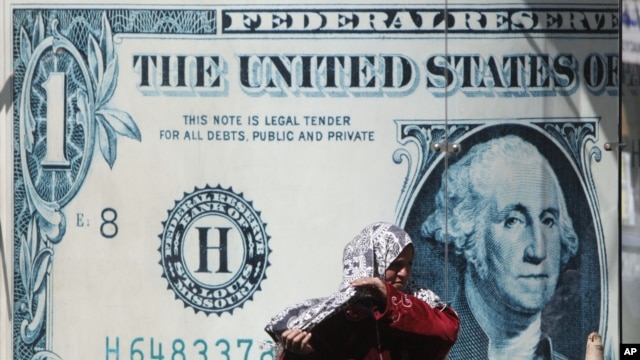
An Egyptian woman adjusts her veil in front of a poster
outside an exchange office. (VOA)

           This past week, the United States grew close to finalizing a deal with Egypt’s new Muslim Brotherhood government and president, Mohamed Morsi, to help Egypt cut $1 billion from its national debt. Aside from the irony of one of the most debt-laden countries helping another nation pay off its own debt, the diplomatic move for the United States promises numerous benefits.
As the new Egyptian political system stabilizes, the Muslim Brotherhood ruling party has set its eyes on dramatically reducing the amount Egypt owes to foreign nations. This past month, President Morsi set off on a whirlwind tour of the world, not only re-establishing diplomatic relations with China, Syria, Russia, and the EU, but also requesting funds to help re-establish democratic relations within Egypt. Overall, Mr. Morsi’s requests have been successful with China pledging $270 million, the International Monetary Fund (IMF) throwing its support behind a $4.8 billion loan, and over $375 million invested by American financiers (in addition to the $1 billion provided by the American government). However, numerous Congressmen and taxpayers are wondering one thing: where does the money that President Obama pledged Egypt come from?

Where is the money coming from?
            The official explanation from Patrick Ventrell, the State Department’s acting deputy spokesman is that the $1 billion is not “new money.” And surprisingly, for once, the government seems to be correct. Like clockwork, the United States has given over $1.2 billion per year in military aid for the past few decades. Throughout the years, the account books have fluctuated back and forth until Egypt came out in the red—owing the US over $3 billion. Essentially, the money that the Obama administration is giving/forgiving out of the Egyptian debt is the money that would have gone to Hosni Mubarak for military support. In other words, the United States regularly gives Egypt $1 billion per year, so this deal is nothing new.
                        Except for the fact that the U.S. has already given Egypt millions this year. According to the 2012 Appropriations act signed by Obama in December 2011, the U.S. would only give to Egypt if the government was "supporting the transition to civilian government, including holding free and fair elections; implementing policies to protect freedom of expression, association and religion and due process of law." However, the act allowed the Secretary of State to waive that requirement, which Hillary Clinton did in March, increasing the amount donated to over $1.7 million per month given to Egypt.

The reason for the charity.
            As usual, there is a method behind the madness. Maintaining a strong U.S. presence within Egypt, either militarily or monetarily, is key to preserving Middle-East accessibility and Egypt-Israel solidarity, notes Patrick Ventrell. As the New York Times reports, given Egypt’s influence in the Arab world, officials said, its economic recovery and political stability could have a profound influence on other nations in transition and ease wariness in Israel about the tumultuous political changes under way.
            It is  an economic fundamental that nothing is free—you always have to give to get. In this case, the U.S. is trading money for security. One question remains unanswered and unasked however: do we even have the money to spend?

_________________________________________________________________________________
Sources:

Wednesday, January 11, 2012

Doomsday...

     The Mayan calender caused consternation when it was discovered that the last date on the stone timekeeper was December 31, 2011. The general populace surmised that the end of the ancient civilization's calender meant that the world would end in 2012, the year not found on the calender. A movie was made, and the tale was immortalized (or at least magnetized), on DVD's all around the world.
The Mayan calender is not the only timepiece that may end this year though.
     Just yesterday, the "Doomsday Clock", a large clock face used by the Bulletin of Atomic Scientists to depict how close the world is to an atomic destruction, moved one minute closer to midnight, bringing the barometer of human fate to 11:55.
     Well, was moved, I should say. The minute hand has fluctuated back and forth over the years, being anywhere between 2 minutes til midnight when the Cold War began, and almost 17 minutes til when the U.S. and Russia signed the START treaty, beginning to destroy nuclear stockpiles. The recent reset is due to several factors, as the co-chairman of the Atomic Scientist board, Lawrence Krauss, says, "Faced with clear and present dangers of nuclear proliferation and climate change, and the need to find sustainable and safe sources of energy, world leads are failing to change business as usual. As we see it, the major challenge at the heart of humanity’s survival in the 21st century is how to meet energy needs for economic growth in developing and industrial countries without further damaging the climate ... and without risking further spread of nuclear weapons — and in fact setting the stage for global reductions."
 
 So a question: is this clock just hype over the nuclear situation of the world, or is the concern real?
     First of all, the mere change of the time on the clock has caused overt amounts of worry and consternation, and though the occurrence has raised awareness, awareness is useless if it is mixed with fear. It is a fact, however, that the world may very well be on the brink of a war. With Iran at some point of the nuclear weapon process, Israel darting suspicious looks at any military occurrence in the Middle East, and with the U.S. still acting in the world as the major keeper of the peace, anything could happen. Russia is sitting back on it's laurels apparently disinterested with the world, yet the laurels it rests upon cover a nuclear arsenal to match the U.S. The end of the world could be right around the corner.
     However, the Doomsday Clock has forgotten one variable to the equation, one that cannot ever be defined. Though the nations involved are large and powerful, the God involved is in control of them all. And while leaders may bluster and threaten, they are powerless to kill and destroy until the appointed time. And when that appointed time comes, they will fight. But, being the end of the world, Christ will return in His glory, and the Doomsday Clock will be reset all the way back to the beginning, though never to tick again.
 
  If the end is near, then so is Christ.